Mold in Phoenix behaves differently than in humid climates. The dry outdoor air means growth almost always traces to a trapped indoor moisture source: a slow supply-line leak under a kitchen sink, a slab crack wicking…
Mold in Phoenix behaves differently than in humid climates. The dry outdoor air means growth almost always traces to a trapped indoor moisture source: a slow supply-line leak under a kitchen sink, a slab crack wicking groundwater in older Encanto-Palmcroft and Willo Historic District homes, or condensation dripping off an undersized AC line set in a Desert Ridge or Ahwatukee Foothills attic during summer. Remediation that skips the moisture source lets the mold return within weeks, so drying the leak comes first, removal second.
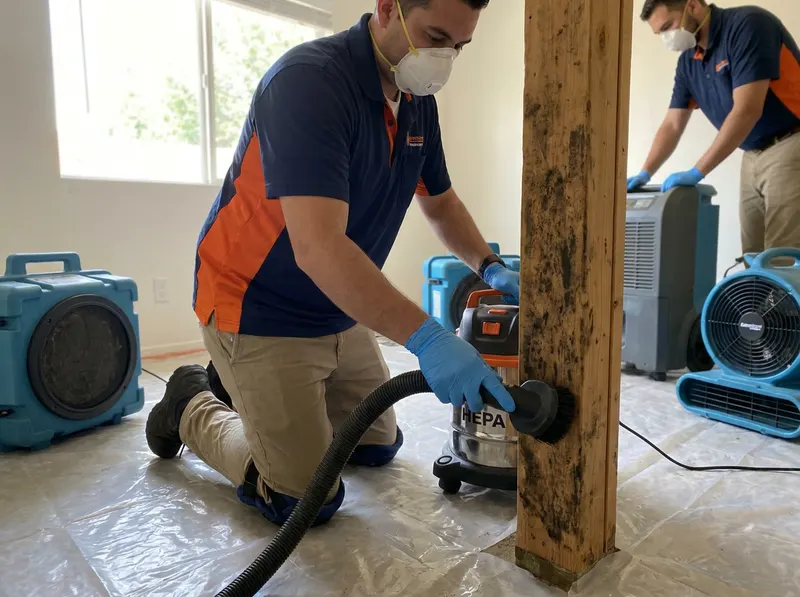
The process runs in order. First, the moisture source is found and stopped, often with a moisture meter reading behind the wall. Second, plastic containment barriers seal the room and a negative-air machine with a HEPA filter pulls spores away from the rest of the house. Third, non-salvageable porous materials are cut out and bagged: wet drywall is removed to roughly 12-24 inches above the visible line, along with saturated insulation and any baseboards or cabinet kick-plates that stayed damp. Fourth, framing and hard surfaces are HEPA-vacuumed and wiped with an antimicrobial. Fifth, the cavity is dried with air movers and a dehumidifier until a meter confirms the wood is back to a normal 12-15% moisture content.
Whether a job needs full remediation or a lighter cleaning depends on size and porosity. A patch of surface mold on a non-porous tile shower wall under about 10 square feet is often a cleanable spot job, not a containment job. Growth spreading across drywall, into insulation, or behind cabinetry in a Sunnyslope or Maryvale rental needs the full contained process because porous materials hold spores you cannot scrub out. If moisture has been present more than 48-72 hours or the affected area passes roughly 10 square feet, containment and material removal is the sound path; if it is a fresh, small, surface spot on tile or metal, cleaning and drying is usually enough. Third-party clearance testing is available for landlords and buyers in Paradise Valley Village and North Central Phoenix who need documentation before a sale or lease.
Insurance often covers mold remediation when it stems from a sudden covered event, such as a burst pipe, but rarely covers long-term neglected leaks. Documentation of the source and the moisture readings is provided for the claim, and the scope is written line by line so there are no surprise line items after the work is done. Homes near Laveen and older Arcadia properties with cast-iron or galvanized plumbing see repeat under-slab issues, so the leak repair recommendation is noted in the report even when it falls outside the remediation scope.
Every job gets a firm, written price after a free on-site visit.
Tell us about your mold removal & remediation job in Phoenix and we'll send a clear, written quote, usually the same day.
 Water Damage Restoration Phoenix